


What are Wisdom Teeth?
Your Wisdom Teeth are your third molar teeth, right at the back of your mouth.
The eighth tooth, counting backwards, on each side, top and bottom. So tooth number 29, 30, 31 and 32.
That is assuming that you have all four Wisdom Teeth present because some people have none, some or all four.
They are left over from a time when we ate a diet of roots, raw meats and tough vegetation requiring tearing and crushing. Early humans had larger jaws and therefore more room to accommodate more teeth to deal with this type of diet.
Why are they called Wisdom Teeth?
Because of when they appear. They usually erupt in your late teens, generally between 17-21 years of age, our college years. They are the last teeth to come through if they do at all.

Why are Wisdom Teeth problematic?
- Often there just isn’t room for them. People now tend to have jaws that are too small for all 32 teeth to fit – 28 is often the most we have room for. So if all the other teeth are present and healthy there may not be enough space for the Wisdom Teeth to come through properly.
- They are difficult to clean because of where they are and therefore are prone to decay.
- It is common, because of a lack of space, for them to come through at the wrong angle. Then they get stuck against the tooth in front or the jaw behind. This makes it almost impossible for them to erupt correctly, this is referred to as an Impacted Wisdom Tooth.
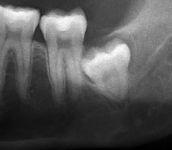
- They will cause overcrowding and upset the alignment, straightness of other teeth. If they are impacted, this will put undue pressure on surrounding teeth, causing them to twist and rotate.
Twisted or rotated teeth are also more difficult to clean and therefore more prone to decay.
- If the Wisdom Tooth is only partially erupted, there is a risk of getting an infection under the gum. As they push up through the gum, the gum can get sore, swollen and inflamed. Bacteria and bits of food can collect under the gum edge, and as it is difficult to clean the area, infections can occur.
What are the symptoms of problem Wisdom Teeth?
• Pain or jaw stiffness near an impacted tooth.
• Pain or irritation from a tooth coming in at an awkward angle and rubbing against your cheek, tongue, or top or bottom of your mouth.
• An infected swelling in the flap of gum tissue that has formed on top of an impacted tooth that has broken partway through the gum.
• Crowding of other teeth.
• Tooth decay or gum disease, if there isn’t enough room to properly clean your Wisdom Tooth and nearby teeth.
What to do if your Wisdom Teeth are causing you trouble.
If you have pain from your Wisdom Teeth then you will need to take some time to visit your Dentist.
However here are a few tips to reduce and alleviate pain if you are at home.
• Ice can help to numb the area if it is applied carefully where you have pain.
• Painkillers can also help.
• Salt water mouth rinses can also be effective. Dissolve 2 teaspoons of salt into 230ml of warm water and rinse around your mouth. This can help to dislodge pieces of food that are trapped in and around your teeth and gums. This should be repeated several times a day.
• Ensure that you clean your teeth properly as trapped food can exacerbate the pain from the Wisdom Tooth and also increase your chance of developing an infection.
How can your Dentist help?
- Taking an X ray will determine the position of your Wisdom Teeth.
- Your Dentist and Hygienist can help you take care of your erupting Wisdom Teeth, clean around them and adjacent teeth and show you how to manage effective cleaning at home.
- They can recommend specific mouth washes, special dental cleaning tools and prescribe antibiotics if required.
- They can remove the problem by extracting the tooth/teeth.
Wisdom Tooth extraction.
People having Wisdom Teeth removed is one of the most common oral surgery procedures performed in the UK. If your Dentist has knowledge and experience of taking out Wisdom Teeth then extraction at your own Practice can be done under local anaesthetic and is preferable to long waiting times, a hospital admission and general anaesthetic.
An X ray will determine how complex the extraction will be and your Dentist will assess the risks and if necessary refer you on to a specialist Oral Surgeon to perform the surgery.
Occasionally there is a possibility of some numbness of the lip after the removal of a lower tooth.
How are Wisdom Teeth removed?
It will depend on their position and the shape of their roots. If your Wisdom Tooth has come through fully then extraction can be as simple as any other tooth. Upper Wisdom Teeth are often easier to remove than lower ones, which are more likely to be impacted.
If the tooth is hidden underneath the gum and is not fully erupted then it may need to be extracted through a surgical excision. Often Wisdom Teeth are extracted in sections, rather than trying to remove it in one go. This dissection of the tooth in your mouth ensures complete extraction and the cleanest technique.
Extractions can also be performed while patients are under sedation but this option requires a Dentist with specific training to administer the sedation drugs.
Should Wisdom Teeth be removed routinely?
No, if there is enough room they can come through into a useful position and cause no more problems than any other tooth.
https://www.dentalhealth.org/wisdom-teeth
What should I expect after a Wisdom Tooth is taken out?
You may experience some swelling for a few days and mild discomfort.
The amount of discomfort will depend on how easy it was to remove the tooth and if you have more than one tooth removed at the time.
It is important to follow any advice you are given which will help with the healing process.
Normal painkillers such as paracetamol or ibuprofen will usually deal with any pain. There may be some stitches to help the gum heal over. Your Dentist will probably want to see you again about a week later to check how your mouth is healing, and to remove any stitches.
Our post dental surgery instruction leaflet can be found via the following link but if you need more information just ask any one of our team.
https://www.stpaulsdentalpractice.co.uk/downloads.html